Estimated reading time: 10 minutes
Tommy Crawford has a long and eventful history in motorycle racing. Born into a South African racing family, Tommy’s father raced until 1955. By 10 years old, young Tommy was actively helping his father to prep his double-overhead-cam racing Velocette. At 12 Tommy bought his own machine, a basket-case 1947 Royal Enfiled two-stroke and managed to get it running without adult help. By 15 Tommy had discovered exotic Italian mopeds and machines such as Maserati, Itom and Garelli. His love of mechanics blossomed, experimenting with porting and carburation.
Crawford became known for his exhaust expertise which developed whilst still in High School with his first race bike. The three speed Kreidler engine received a two-speed Itom transmission via spur gears to create an effective C/R six-speed, albeit with two shifter mechanisms requiring one hand and one foot!
Bitten by the racing bug
In 1964 Crawford began his own racing career. His maiden win came in 1966 along with sponsorship by the South African Kreidler importer. He won four Transvaal Championships and set many lap records along the way. As the 1970s began Tommy opened the first of his two Suzuki and Kreidler dealerships. He switched to production racing achieving a 200cc National Title, 250cc class wins and eventually campaigning a 500 four.
Upon selling the businesses in 1976 Tommy moved to California where he met Darryl Bassani who offered him a position as a prototype designer. During this time Crawford began building his first frame – a back-bone design for his TZ250. The machine was brought to Europe in 1978 via Steve Parrish, he brought the bike over in pieces and reassembled it on arrival. The season was spent as spannerman for fellow compatriot Dirk du Plooy who was racing a 350. The pair visited Grand Prix in Belgium, France, Italy, Holland and Britain. They had little success but learned a lot along the way.
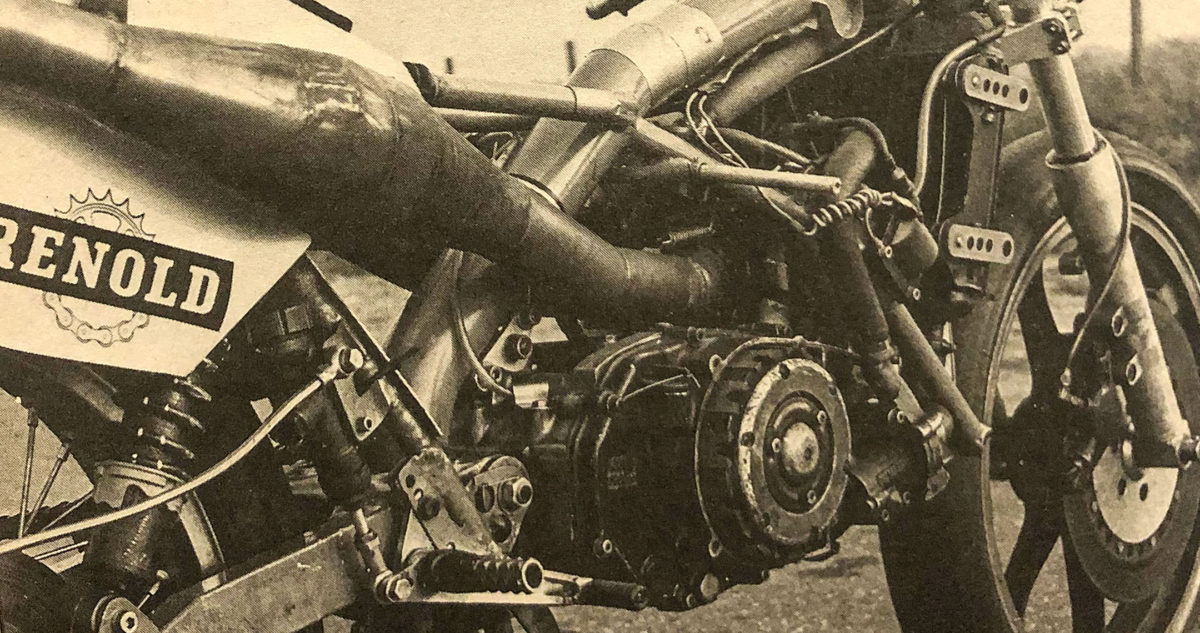
↑ Tommy Crawford designed and developed his own spine-frame design
Continued development
In 1978/9 Crawford met Dudley Cramond, a talented South African rider. The spine-frame continued to receive development with Cramond onboard racing International meetings in South Africa. The concept was revisited in several incarnations including KR250 and Rotax engines. During this time Tommy set up his UK-based racing exhaust business, T C Exhausts after a spell using the workshop of Jim Lomas in Wymondham. Tommy built the cone roller Jim used to make his own pipes. TC Pipes were used by fellow reverse cylinder designer Chris Mehew.

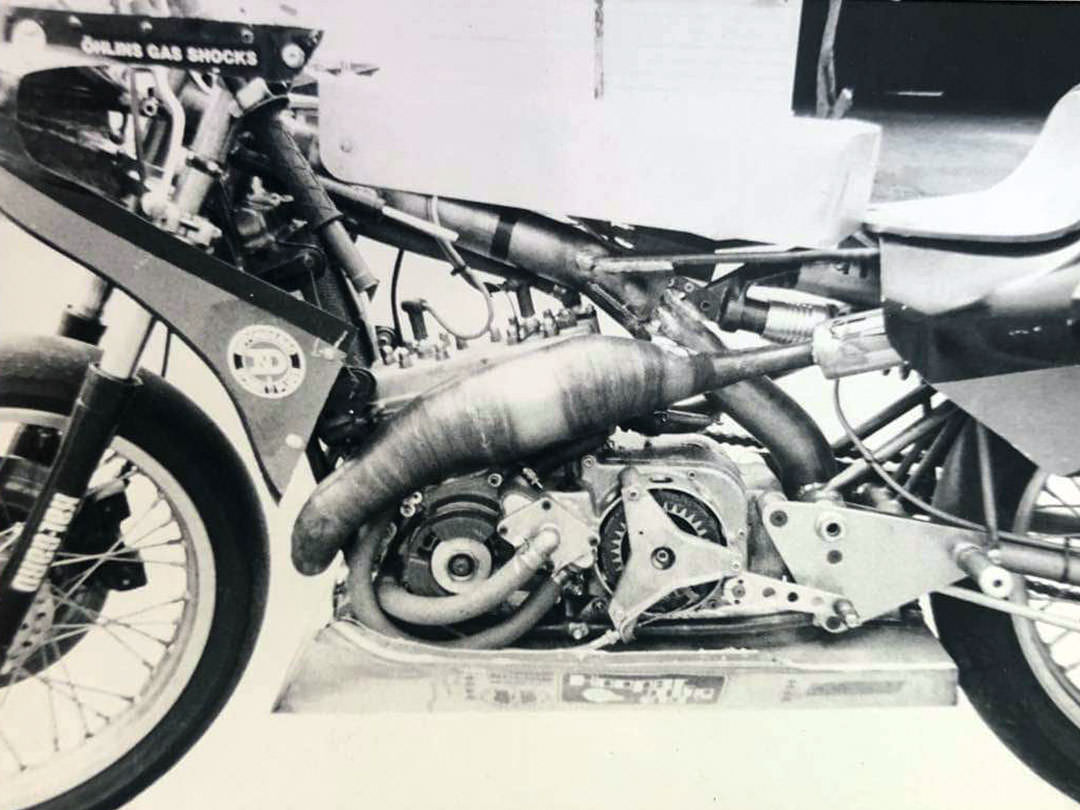


↑ The Rotax engined reverse cylinder machine designed and built by Tommy Crawford
Dirk du Plooy
Dirk du Plooy only rode the first version as shown in the photograph and was the first rider. He practiced at the Belgian GP at Spa but failed to qualify when the bike had mechanical problems during the two qualifying sessions. Tommy shipped the bike over from the USA in 1978 ready for it to be ridden for the first time. Dirk only rode the unusual machine a few times during 1978. We would like to thank Dirk’s family for use of the photos and info supplied by Dirk himself. He sadly passed away whilst we were preparing this article.
Tommy made the frame. It was a single tube steel spine frame. It wobbled like crazy initially so we used shorter rear shocks. It used Hunt alloy hard chromed discs.
Dirk du Plooy

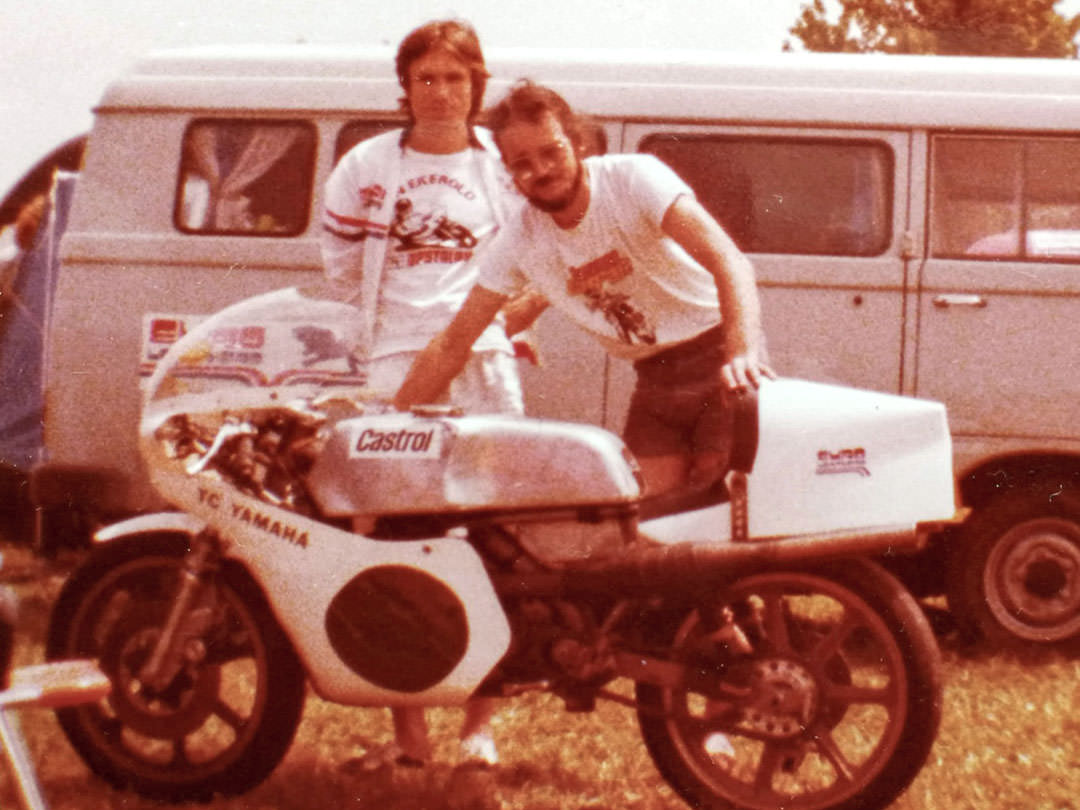
↑ First image: Dirk in his motorcycle shop, TD Agencies, and racing in South Africa
↑ Second image: Dirk sporting his Jon Eckerold t-shirt with Tommy Crawford in 1978 at Amstetten in Austria.

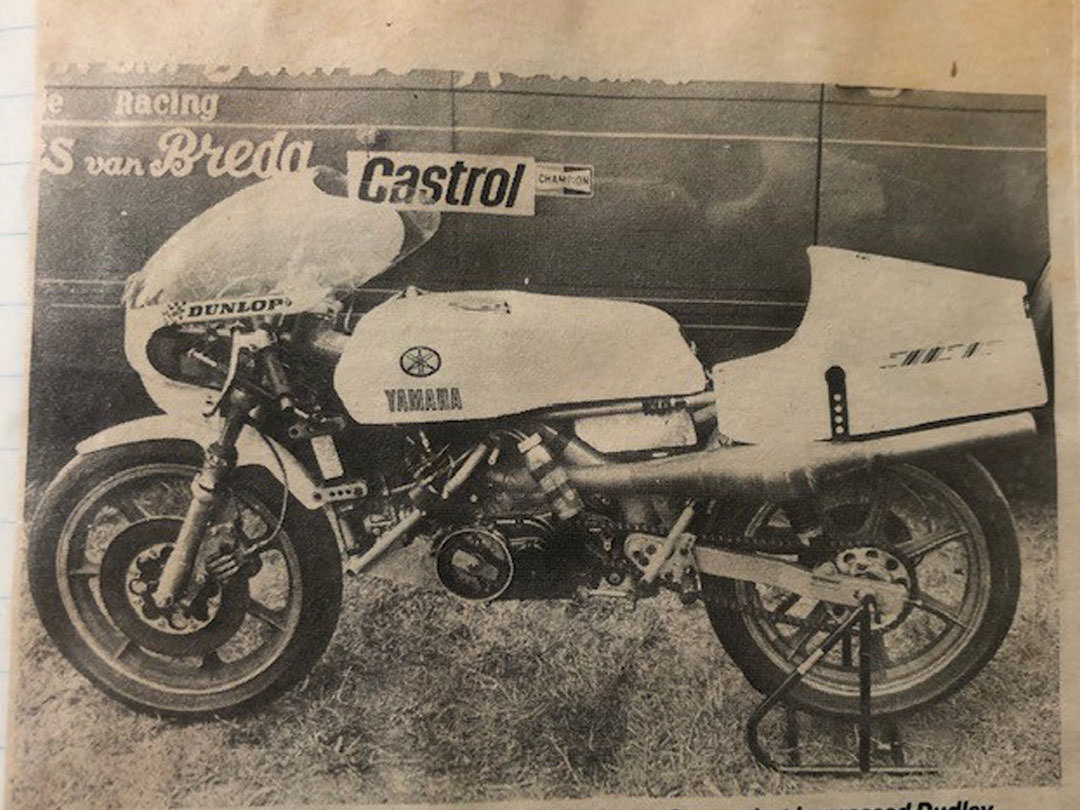
↑ Magazine article about Dudley Cramond – the photograph is actually of the Chris Mehew reverse, wrongly attributed to Crawford.
Dudley Cramond
Dudley Cramond was described as having an uncompromising, wheelie-punctuated riding style that brought him to the attention of commentators and press, raising many a spectators pulse rate. In his early career in South Africa, the young rider won the 1974 350cc Championship at just 19, beating both Alan North and Jon Eckerold. Cramond went on to secure top three National Championship finishes on 750 and 900cc machinery plus a works 700cc ride for 1977.
Cramond suffered a severe knee injury in a car accident which resulted in losing the ’77 championship by a single point, but not before setting outright lap records at Kyalami and Pietermaritzburg that remain unequaled. At the end of 1977, Dudley arrived in the UK, finding success on a Harrold Coppock 350 Yamaha and a Hyspec Engineering 250cc. Consistent top five results followed at the North West 200, Scarborough and a host of top British short circuits, campaigning both National and International events. Cramond finished 4th in the Vladivar Vodka 250 Championship plus wins in the 250 and 350 Bill Ivy Trophy.
Shifting into reverse
Dudley Cramond and Tommy Crawford teamed up on the self-built, spine-framed 250. The chassis was made from raw stock round Chromoly tubing with a rectangular section used for the swingarm and twin-shock suspension. Every part of the unique chassis and swingarm was handmade by Crawford.
Cramond and Crawford began with the first incarnation of the spine frame, as used by du Plooy earlier in the year. It had Ceriani forks and triple clamps and S & W twin shocks. The front disc was plated aluminium combined with a Yamaha caliper. Cramond recalls that when riding the bike with this set-up he had to sit very still as it was rather unstable. Subsequently, they changed the front end to 1978 TZ forks, yokes and brakes which fixed the instability issues by providing much less offset and the correct amount of trail.
I tested the above changes, and what a difference, now I could feel the front tyre, it felt like it was stuck to the track surface, and I could move about on the seat as much as I wanted without upsetting the bike.
Dudley Cramond
Further updates included a Harris Performance modification to the frame and swingarm to convert the chassis to a monoshock set-up. They used a Decarbon unit without a remote reservoir. Harris provided welding and fabrication support and were an invaluable resource. Dudley says they only raced the Harris version once in South Africa then sold it as they were heading back to the UK. There were six main frame tubes made in total, Tommy built each frame and swingarm from his own knowledge, with no software assistance involved at this time.
The bike’s 1975 TZ engine was fitted with the latest 1978 cylinder ad modified head. Tommy fitted the cylinder with his own design of exhaust and manifolds facing the rear. The bore and stroke was 54mm x 54mm at 247.3cc.
Going racing
Cramond campaigned the reverse cylinder machine in 1978 with some excellent results. At their very first outing at an International meeting held at Oulton Park, he finished in 6th place after starting way back in 28th.
- 3rd : Mallory Park, Race of the Year
- 2nd : Scarborough
- 1st : Cadwell Park Bill Ivy Trophy
- 4th : Vladivar Vodka Series – this machine played a bit part throughout the season
At a Donington Park International event, Cramond suffered a crash on the last lap whilst in second place behind Kork Ballington. The unfortunate incident involved Mick Grant, Vic Soussan and Tony Rutter – “My apologies guys”
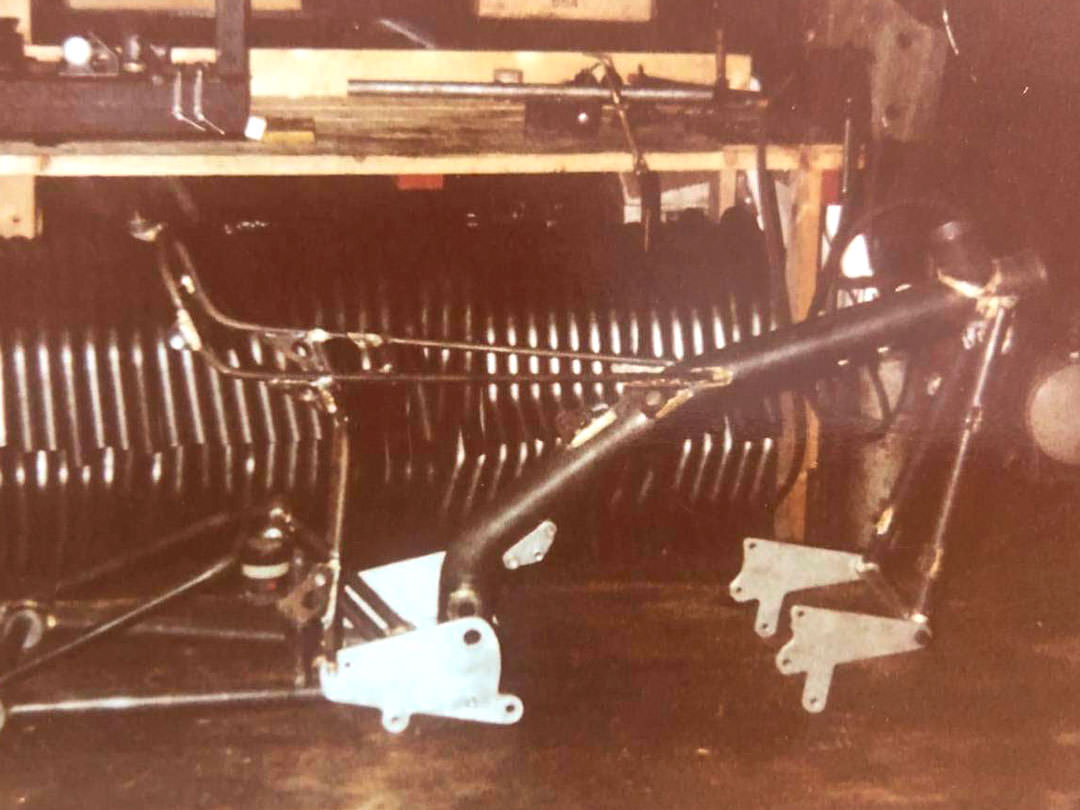
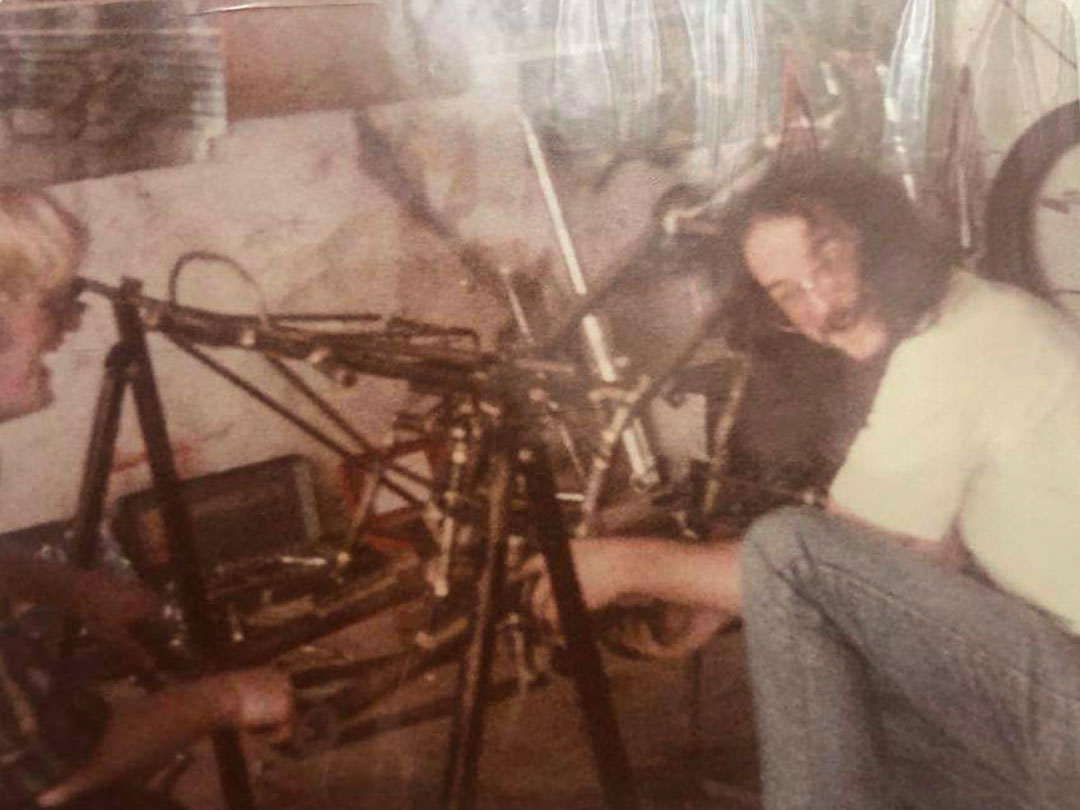
↑ Image one: The first incarnation of the spine-framed design by Tommy Crawford.
↑ Image two: The early spine frame design, ready for an RD400 engine.
↑ Image three: Tommy and Dudley working on the Harris framed version in 1978.
Long lasting friendships
Today Tommy and Dudley are still firm friends and live two doors away from each other in California.
I asked Tommy for information on how he built his chassis. He said he drew it out and lay everything on the ground, placed all the parts where they should be with the steering head angle at 27 degrees and swingarm drop at the angle he wanted. That way he found the angle he needed to machine the main frame tube where the steering head was mounted
Dudley Cramond
Read the Motorcycle Racing Magazine article featuring the Crawford Yamaha reverse cylinder 250. Find out ‘Why Cramond’s Yamaha is so special’
The bike as it is today
Tommy Crawford still owns this inspired machine and has fully restored it. The first frame was retired due to damage sustained in a crash. Version II came to life in 1980 and version III is the one shown in the photographs below that he still owns today. It was raced extensively by Danny Cashen, including 16th place at Daytona in 1981. The Rotax-powered incarnation of the version III chassis was built in 1981 and sold approximately 15 years ago.
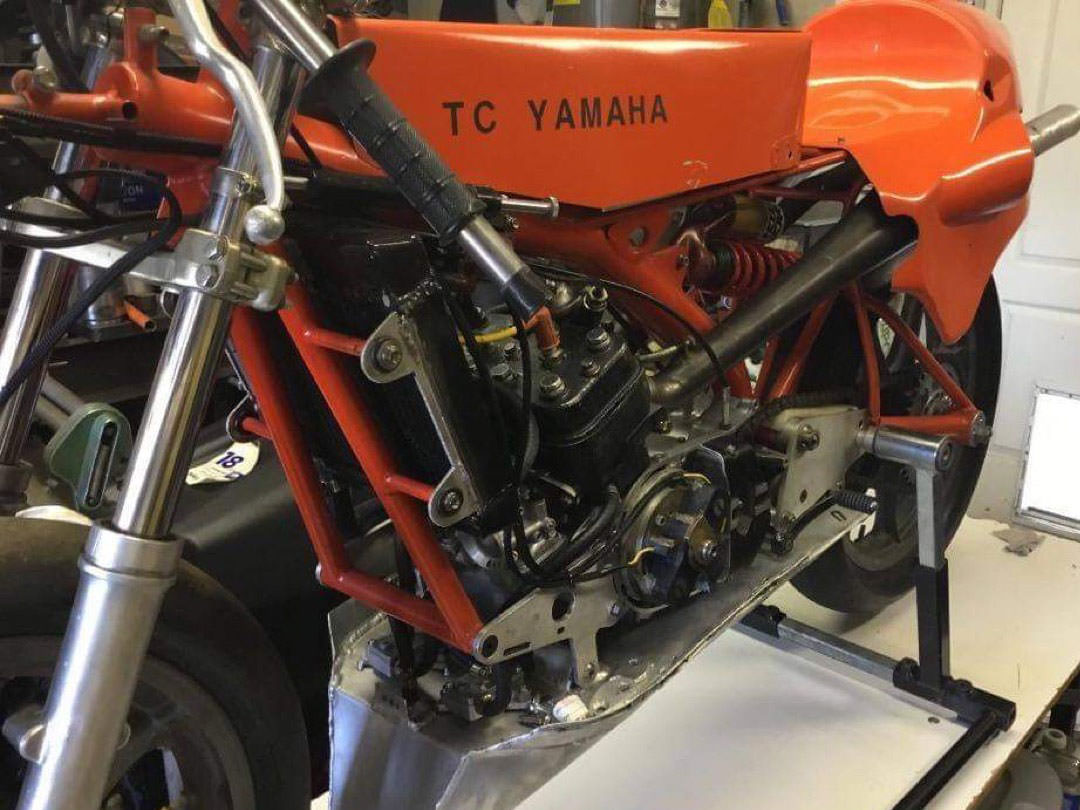

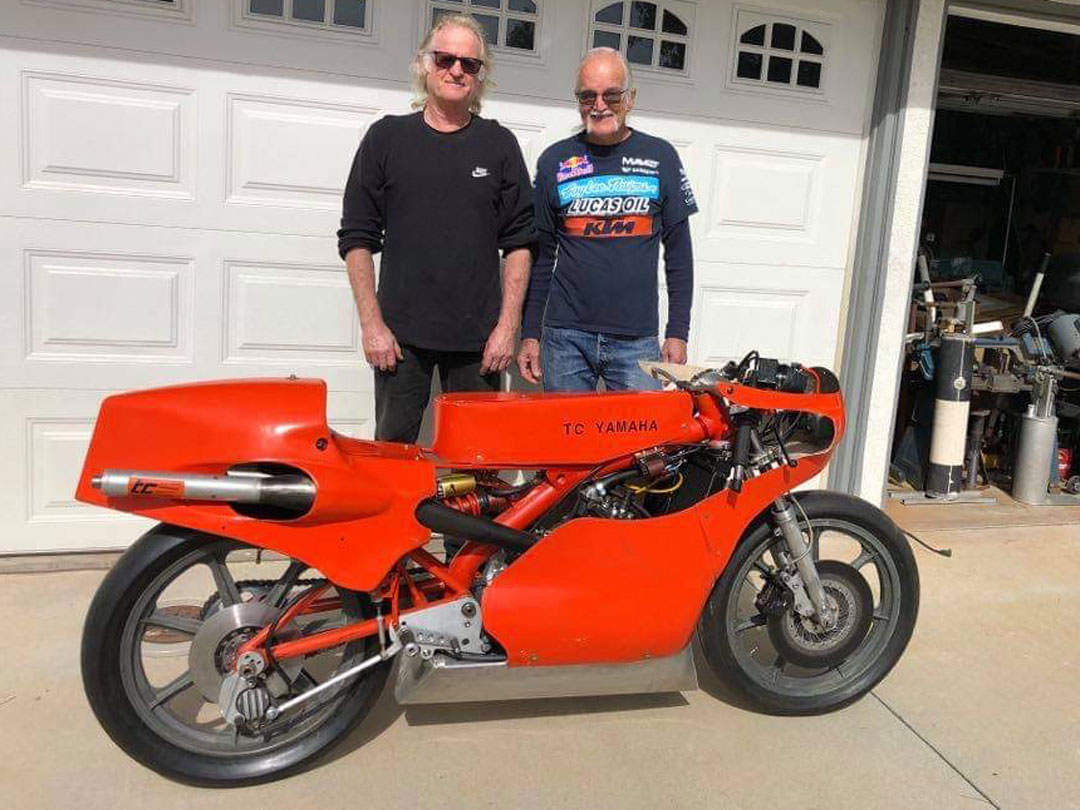
↑ Image one: The Version III as it exists today
↑ Image two: Version III monoshock with Crawford’s own pipe design
↑ Image three: Dudley Cramond (on the left) with Tommy Crawford.